India Tightens Gold Import Rules as Rupee Falls to Record Low
05/16/2026 / By Sterling Ashworth

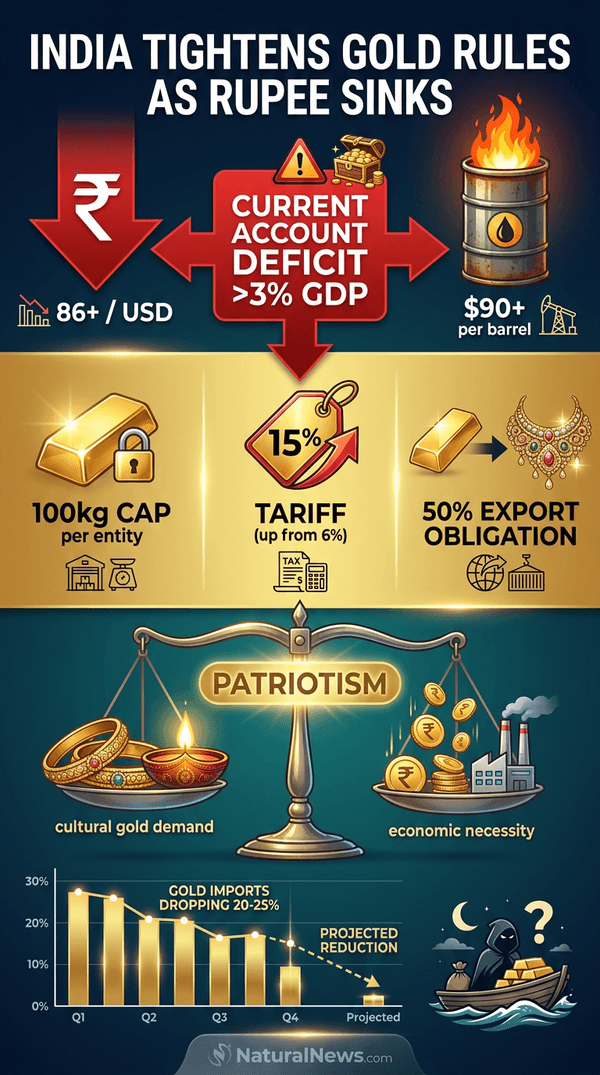
India imposed new restrictions on gold imports, capping individual exporters at 100 kilograms and linking future approvals to export performance, according to a government notification cited by ZeroHedge.
The notification reported on Thursday, May 14, applies to imports under the advance authorization route, typically used by exporters to bring in duty-free gold for processing. [1] It follows a series of escalating measures.
Two days prior, India more than doubled import tariffs on gold and silver to 15% and 6%, respectively, as Prime Minister Narendra Modi urged citizens to forgo gold purchases and unnecessary foreign travel to help stabilize the currency. [2] [3] The rupee has fallen to record lows against the U.S. dollar, driven by higher oil import bills amid the Middle East conflict and foreign-exchange outflows. [1]
Background: Rupee Weakness and Gold as Key Import
India, the world’s third-largest oil importer, has been hit hard by energy disruptions in the Persian Gulf, according to reports. [1] The current account deficit, which includes the trade balance of goods and services, has widened as oil costs rise.
As Singh Kavaljit explains in “Taming global financial flows,” the current account comprises merchandise and invisible accounts, and widening deficits put pressure on currency reserves. [4] Gold is India’s largest import after crude oil, and demand has shifted from jewelry to investment holdings, with a growing share of imports moving into financial holdings including ETFs, according to UBS analysis cited by ZeroHedge. [1]
The Reserve Bank of India has been selling dollars to support the rupee, but the currency continues to slide, according to the report. [1] Gold prices have surged amid geopolitical tensions, with gold hitting an all-time high of $3,749 per ounce in September 2025. [5]
During the classical gold standard, central banks would raise interest rates sharply to attract gold, as described by Murray Rothbard in “A History of Money and Banking in the United States.” [6] India’s current approach of restricting imports rather than raising rates reflects a different policy framework.
New Restrictions on Gold Imports
The government notification dated May 14 limits bullion imports under the advance authorization route to 100 kilograms per entity, according to ZeroHedge. [1] Subsequent imports require exports equivalent to 50% of the imported value, and first-time applicants face stricter checks, the notification stated. The advance authorization route is typically used by exporters to import duty-free gold for processing; the new rules effectively cap per-participant access. [1]
The restrictions come on top of a surprise tariff increase on May 13, when India doubled import duties on gold and silver, raising the effective import tax from 6% to 15%, according to reports. [7] The government has also linked future import approvals to export performance, according to the notification. [1]
Expert Analysis and Market Impact
Economist Madhavi Arora of Emkay Global Financial Services said the moves underscore policy concerns about curbing import-led dollar outflows. “We expect gold imports to fall by around 20-25% this year due to these steps,” Arora said, as quoted by ZeroHedge. [1] UBS analysts noted that the restrictions do not directly limit importing banks but reduce each participant’s ability to build positions, tightening flows through the system, according to the report. [1]
Demand has already been soft in recent weeks, as reflected in muted purchases during the Akshaya Tritiya festival in April, when record gold prices curbed jewelry purchases, according to Reuters via ZeroHedge. [8] The broader backdrop is that India’s gold demand has become more investment-driven, UBS noted. [1]
Outlook: Smuggling Risks and Alternative Assets
Previous tightening cycles led to increased gold smuggling, according to the ZeroHedge report, as buyers sought to preserve purchasing power through unofficial channels. [1] The report stated that if onshore market constraints persist, Indian investors may turn to non-fiat alternatives such as tether and bitcoin. [1] Tokenized gold and other hybrid approaches face legal barriers, as centralized structures are often targeted by governments seeking to retain control over money, according to Aaron Day in an interview with Mike Adams. [9]
Government officials said New Delhi is weighing further emergency steps to shore up foreign-exchange reserves, according to the report. [1] The global shift toward precious metals and de-dollarization continues, with analysts predicting gold could reach higher levels, as noted in an edition of the “Health Ranger Report.” [10]
References
- India Panics, Further Tightens Gold Flows As Rupee Collapses. ZeroHedge. May 14, 2026.
- India More Than Doubles Gold, Silver Tariffs To Defend Crashing Rupee. ZeroHedge. May 13, 2026.
- Why Modi wants Indians to buy less gold and take fewer foreign holidays. BBC News. May 15, 2026.
- Singh Kavaljit. “Taming global financial flows challenges and alternatives in the era of financial globalization a citizens guide”.
- Willow Tohi. “Gold market turbulence and geopolitical shocks drive precious metals to historic heights”. NaturalNews.com. September 24, 2025.
- Murray Rothbard. “A History of Money and Banking in the United States”.
- India doubles tariffs on gold and silver. RT. May 13, 2026.
- Muted Demand During India’s Second-Biggest Gold-Buying Festival, After Prices Surge. ZeroHedge. April 25, 2026.
- Mike Adams interview with Aaron Day. August 25, 2025.
- Kevin Hughes. “Health Ranger Report: David Morgan Elaborates on the U.S. Dollar’s Decline and the Rise of Precious Metals”. NaturalNews.com. May 7, 2025.
Explainer Infographic
Submit a correction >>
Tagged Under:
bubble, currency crash, currency reset, debt bomb, debt collapse, gold, gold imports, gold report, import rules, India, market crash, metals, money supply, Narendra Modi, Precious Metals, reserve bank of india, risk, rupee
This article may contain statements that reflect the opinion of the author
RECENT NEWS & ARTICLES